
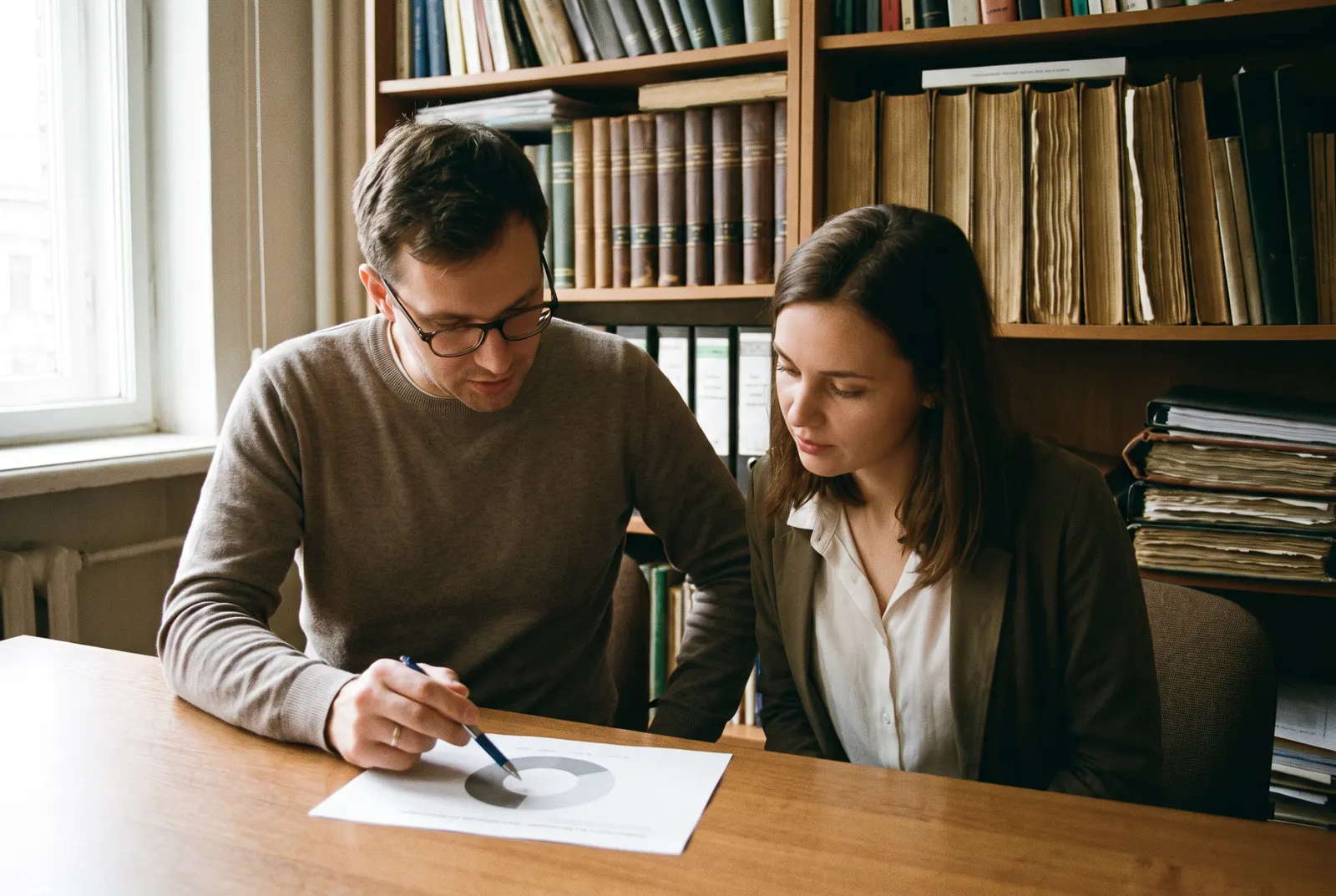
In a divorce, a forensic accountant works out what a couple’s money really looks like: which accounts exist, what income is real, what a business is worth and where funds went. Most are CPAs, retained by one side’s attorney, appointed by a court or hired jointly. If you want to do this work yourself, the path runs through accounting, valuation and a credential or two.
What Does a Forensic Accountant Do in a Divorce?
One spouse often manages the money, which can leave the other with a thin picture. Your job would be to fill it in. New Jersey CPA magazine says as much, and it describes the accountant’s job as turning records into clarity in a legal setting. You’d use accounting, auditing and investigation skills. Divorce is decided under state law, so we’ll flag when an example comes from one state.
A California family law firm, Fenchel Family Law, says most of the work you’d do falls into four engagement types. A single case can involve more than one.
| Engagement type | The main question | Common situations |
|---|---|---|
| Income determination | How much does each spouse actually earn? | Self-employment, bonuses, equity, cash businesses |
| Business valuation | What is the business or practice worth? | Closely held companies, startups, professional practices |
| Asset tracing | Where did the money go, and whose is it? | Commingled accounts, separate property claims, suspected concealment |
| Lifestyle analysis | What did the marriage actually cost to live? | Spousal support disputes, high-income households |
Your raw material is records. HBK CPAs and Consultants lists bank statements, tax returns, investment accounts, credit records and business records. The New Jersey article adds that many CPAs lean on four core documents: financial accounts, tax returns, tax information from the IRS and credit reports.
You’d touch support figures too. HBK says verifying income for self-employed people, or for anyone paid in bonuses and stock options, helps ensure alimony and child support reflect what each person can really pay. It also notes that settlements carry tax effects. The IRS explains how it treats alimony payments for federal tax purposes, which is one reason tax knowledge helps in this field.
How Do Forensic Accountants Find Hidden Assets and Income?
You’d start with a few well-worn tests. Two tax accountants at the law firm Duane Morris describe the techniques you’d use for income and spending.
| Technique | What it tests |
|---|---|
| Lifestyle analysis | Whether reported income is enough to support the family’s expenditures |
| Net worth comparison | Whether reported income over a period matches the change in net worth between two or more dates |
| Bank deposit analysis | Whether deposits line up with reported income |
| Disbursement review | Payments out of bank and brokerage accounts, which can show a spouse dissipating marital assets before separation |
For assets, you’d look at tax returns, personal and business financial statements, loan applications and public records, the same authors say. You’d also learn how money hides. HBK lists transfers to friends or family, shell companies, deferred income or bonuses and large purchases. Duane Morris adds withdrawing unreported cash from a closely held business and deferring a bonus until after the divorce.
You’ll see some red flags again and again. A Florida forensic CPA, Joey Friedman, lists unexplained transfers from joint accounts, sudden cash-heavy spending, an income drop right before filing, an undisclosed business interest and a lifestyle that doesn’t match reported earnings.
Claims about spending also come up. A CPA and divorce financial analyst on the Modern Family Matters podcast describes a workflow of organizing financial disclosures, building a marital balance sheet and following money across accounts. The episode also covers dissipation claims, where marital funds support things like trips or gifts.
How Does a Forensic Accountant Value a Business in a Divorce?
This is where many engagements get hard. The Duane Morris authors say a closely held business is often the largest asset in the marital estate, so an accurate valuation is essential.
The appraiser usually values the company on its “normalized” income, and that number can’t be trusted if business and personal spending are mixed together. The forensic accountant’s work can go to the appraiser to help reach a realistic value.
Complexity changes your workload. The New Jersey article notes that a primary residence is easier to value than a multi-location business, and the second needs more training. You’d also sort out timing. HBK says, depending on when a business was acquired, all of its value or only its growth during the marriage may count as marital.
You’d run into tactics too. HBK cites insights from the American Academy of Matrimonial Lawyers that include inflating liabilities, delaying income and disguising personal expenses as business costs. The podcast guests call self-employed income and business valuation the hardest issues in divorce.
Valuation isn’t only a CPA field. The ABA deskbook author says the business valuation world is much larger than CPAs, and several organizations credential valuation experts. That’s why the credentials below matter.
What Do Reports, Consulting and Testimony Look Like?
The report is your product. Fenchel says a good one explains what the records show, how the accountant reached conclusions and what they mean for the case, in language clear enough for a judge and detailed enough to survive cross-examination.
Whether anyone sees it depends on your role. If you’re consulting, your findings may go only to the legal team. If you’re testifying, your report is usually shared with the other side before trial.
Duane Morris describes a common setup in which one CPA does valuation work that is subject to discovery, while a second forensic CPA acts as a consultant under the Kovel rule, so findings are generally protected by attorney-client privilege.
Most of the time you won’t be on the stand. The New Jersey article says most engagements won’t need expert testimony, but attorneys hire the accountant so they can use the accountant as an expert in court. It also recommends hiring in stages, so the spouse can approve more work as findings emerge. Its author’s stated goal is “full transparency for both parties” so a settlement can be equitable.
If testimony does come, the ABA author says many forensic accountants enjoy “the sporting and sparring of a deposition” and the challenge of staying calm under pressure. The AICPA also has a rule book for you. Its Statement on Standards for Forensic Services applies to members, and employees of member firms, who provide services in a litigation or investigation engagement, effective January 1, 2020.
How Do You Become a Forensic Accountant Who Works on Divorce Cases?
You won’t find a single license for the specialty. This table shows the path the sources describe.
| Step | What you do | What the sources say |
|---|---|---|
| 1. Build the accounting base | Earn an accounting degree and work toward the CPA | The BLS says every state requires 150 semester hours of coursework for CPA candidates, which is 30 more than a usual bachelor’s degree |
| 2. Work in tax or audit | Gain a few years of experience | The ABA author says CPAs usually start in tax or audit and add forensic work through courses, tests and experience |
| 3. Add forensic and valuation coursework | Take litigation support, fraud and valuation classes | See the programs below |
| 4. Earn credentials | Add the CFF, ABV, Certified Valuation Analyst (CVA) or CFE credential | See the table in the next section |
| 5. Build relationships with attorneys | Meet family lawyers and give them reasons to call you | The ABA author says a healthy practice can rest on 20 or so litigators |
The technical jump may be smaller than you expect. The ABA author says almost all CPAs with a few years of experience already have the basic skill sets for the work. The harder part is finding clients. He calls marketing professional services one of the typical accountant’s least favorite activities, and says successful forensic accountants socialize with lawyers at bar meetings, speak at conferences and present continuing legal education.
A word of caution from an r/Accounting thread in 2026: one commenter said moving into forensic work is similar to moving into internal audit, with a risk of getting pigeonholed in a field that’s a million miles wide. The advice on the same thread was to get your CPA first and the CFE after. Both points are worth weighing before you commit to divorce work alone.
Which Credentials Fit Divorce Work?
Five credentials will come up as you plan. You don’t need all of them, and the table shows who can hold each.
| Credential | Issued by | Who can hold it and what it asks | Why it comes up |
|---|---|---|---|
| CFF | AICPA | CPAs and AICPA qualified equivalents. The Global Standard pathway asks for 1,000 forensic business hours, 75 hours of professional development within five years and a 175-question exam in one 4-hour sitting | The AICPA positions it for litigation support and family law support services |
| ABV | AICPA | AICPA members. CPAs need a valid license or certificate, 1,500 hours of valuation experience and 75 hours of valuation-related professional development in the five years before applying. Finance professionals who aren’t CPAs need 4,500 hours | Valuation for litigation and disputes, among other uses. Holders need 60 hours of valuation-related continuing education over three years |
| CVA | National Association of Certified Valuators and Analysts (NACVA) | O*NET describes an associate-level education or higher plus more than 2 years of experience, or a core-level NACVA certification | NACVA lists divorce among the situations that demand a determination of value |
| CFE | Association of Certified Fraud Examiners (ACFE) | 40 points to sit the exam, 50 points plus two years of fraud-related experience to be certified | A Kentucky firm lists it among the credentials on its matrimonial team |
| Certified Divorce Financial Analyst | Institute for Divorce Financial Analysts | Focuses on the financial impact of a settlement. Some CPAs and CFEs hold it | Separate from forensic work, and often paired with it |
A Kentucky CPA firm, Dean Dorton, says its experts hold CPA, CFF, ABV, CVA and CFE credentials and testify in courts regionally and nationally. That’s one way the pieces stack. Our guides to the CFF credential and the CFE credential explain the two you’re most likely to meet first, and the CFE versus CPA comparison helps if you’re choosing between them.
Choose by the part of the work you like. If tracing money and writing reports appeals to you, the CFF and CFE point that way. If valuing companies does, look at the ABV and the CVA.
Which Programs Teach Divorce-Related Forensic Skills?
Few programs name divorce directly. Of the 65 programs we track, 25 quote a valuation course or valuation skills from the school’s own pages, and 21 quote litigation support. Another 17 quote expert witness training, and 7 name divorce, matrimonial or family law topics.
Montclair State University lists matrimonial accounting among the technical areas of its Forensic Accounting Graduate Certificate. You’d take four graduate courses that include Business Valuation, Fraud Examination and Legal Issues in Forensic Accounting, and the format is hybrid.
George Mason University lists divorce among the contemporary topics in its Advanced Topics in Fraud course, beside litigation support and bankruptcy. Its graduate certificate also includes a Business Valuation course, can be taken fully online and can help you reach the 150 credit hours for a CPA license.
St. Thomas University offers a fully online graduate certificate. Its Forensic Accounting course surveys valuation, economic damages, fraud and family law, and stresses the role of the forensic accountant as a team member in resolving complex legal issues.
Rider University teaches a Business Valuations course on valuing a closely held business with no market price. You can take the fully online certificate on its own or inside the Master of Accountancy with no additional courses.
Stevenson University pairs Business Valuation with Litigation Theory and Practice in its fully online Master of Science in Forensic Accounting.
Southern New Hampshire University builds the interview and presentation side. Its fully online accounting bachelor’s at $354 a credit includes courses on fraud interviewing and legal aspects and on presenting findings to stakeholders.
Purdue University Global covers the court side. Its Fraud and Forensic Accounting course, in the accounting and analytics bachelor’s at $371 a quarter credit, teaches collecting evidence, providing legal support and testifying in court.
Compare more master’s programs in forensic accounting and graduate certificates in forensic accounting.
What Is Hard About This Specialty?
You should weigh three things. First, your demand follows complexity. Fenchel says a forensic accountant may not be needed when both spouses earn W-2 wages, the assets are straightforward and the records are complete, and it says many divorces don’t reach the threshold where the answers change the outcome.
Second, you’d work in an emotionally charged setting. The New Jersey article calls divorce complex and emotionally charged, and you’d work between spouses, lawyers and a judge. Third, you may wait on others. Your analysis depends on records the other side or a third party has to produce.
The cost question follows the specialty around. The New Jersey author says a common question is “Is the squeeze worth the juice?” and Duane Morris suggests a cost-benefit check before an engagement. As the accountant, you’d be the person helping answer that.
What Can You Earn as a Divorce Forensic Accountant?
You won’t find an official wage figure for this specialty, because the BLS doesn’t publish one. The closest national series is accountants and auditors, which had a median of $83,680 in May 2025. That number covers every kind of accountant, so don’t read it as divorce forensic pay.
Your income depends on your setting. The ABA author describes building a private practice around a core group of litigators, and firms with matrimonial teams, like those above, are another route.
Fee figures that circulate online describe what clients pay, not what you’d earn, so we leave them out. Our forensic accountant salary guide has the closest pay data we can source, and the forensic accountant career guide covers the broader field.
Frequently Asked Questions About Forensic Accountants in Divorce Cases
Do Forensic Accountants Only Work on Divorce Cases?
Does a Forensic Accountant Have to Be a CPA to Work on Divorce Cases?
Can a Forensic Accountant Find Hidden Bank Accounts?
What Is the Difference Between a Forensic Accountant and a Divorce Financial Analyst?
Can a Court Appoint a Forensic Accountant in a Divorce?
How Long Does a Divorce Forensic Accounting Engagement Take?
Which Credential Should You Earn First for Divorce Work?
Sources
- The Role of Forensic Accounting in Divorce Proceedings
- The Role of Forensic Accounting in Divorce
- Forensic Accountants in Divorce
- How a CPA Becomes a Forensic Accountant in a Tennessee Divorce Case
- Forensic Accountant for Divorce
- When to Hire a Forensic Accountant in a Divorce: Red Flags
- Inside the Money Wars: Divorce Forensic Accounting and High-Stakes Litigation
- Matrimonial Dissolution
- Statement on Standards for Forensic ServicesAccredited in Business Valuation (ABV) CredentialPathways to the CFF CredentialCertified in Financial Forensics (CFF) Credential
- ABV Credential Requirements
- Certified Valuation Analyst
- Business Valuation and Financial Forensics Credentials
- CFE Credential Eligibility
- CDFA Profile
- Alimony and Separate Maintenance Payments (Topic No. 452)
- Accountants and Auditors: Occupational Outlook Handbook
- New CPA Licensure Pathways and CPA Mobility
- Advice for Someone Interested in Forensic Accounting? (r/Accounting thread, 2026)
- Forensic Accounting Graduate Certificate
- Accounting Courses (ACCT)
- Graduate Certificate in Forensic Accounting (Online)
- Forensic Accounting Graduate Certificate
- School program and tuition pages (each review links the pages we checked)
Sources retrieved to .