
You become a forensic accountant by earning a bachelor’s or master’s degree in accounting, finance or a related field, working one to three years in general accounting or audit, and then adding credentials like the CPA license, the CFE or the CFF. Which ones matter most depends on where you want to work, and the steps below show you how to sort that out.
What Does a Forensic Accountant Do?
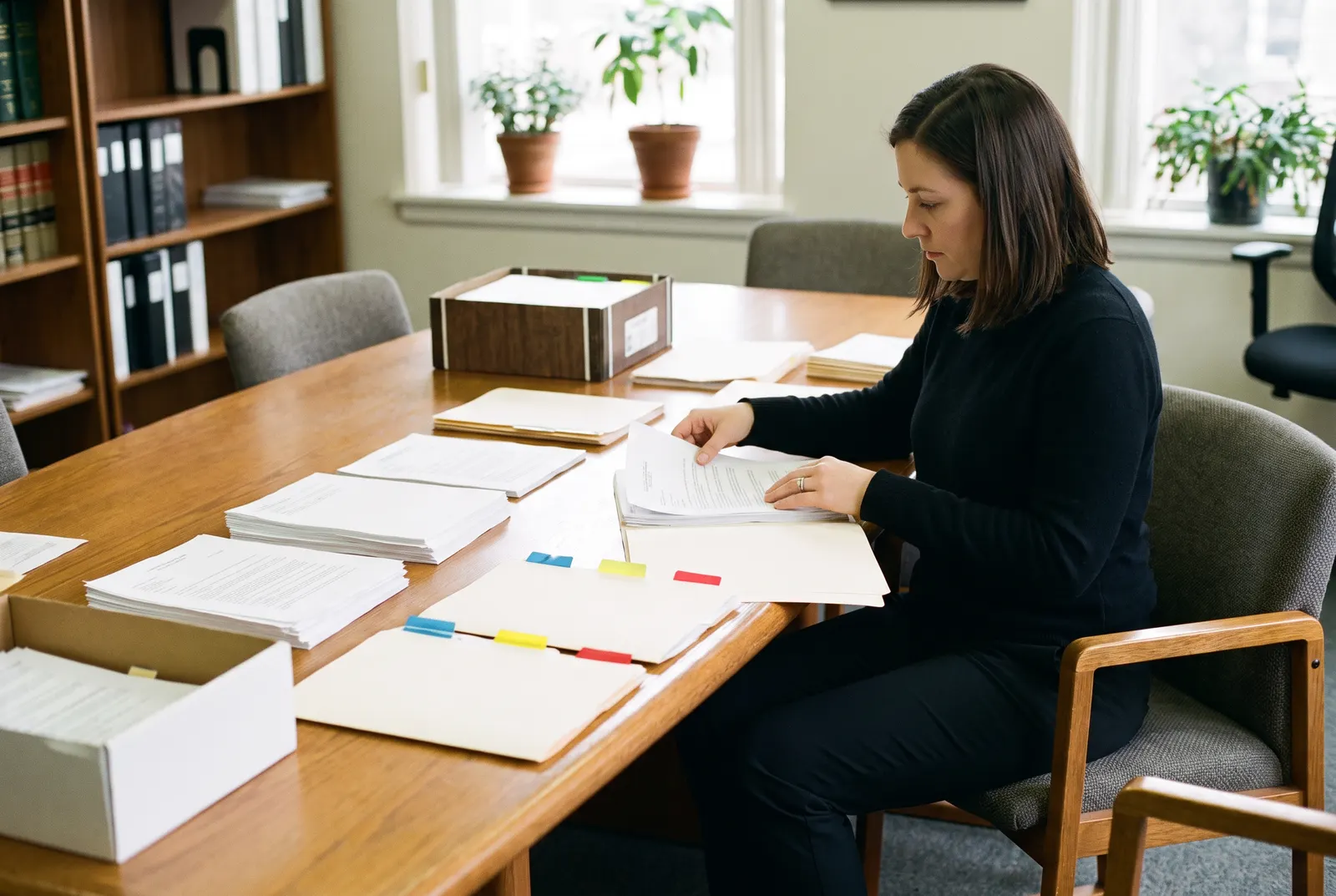
A forensic accountant follows money that somebody tried to hide. The ACFE says the role combines accounting knowledge with investigative skills in litigation support and investigative accounting settings. It names four duties that set the job apart: tracing funds to find assets that can be recovered, analyzing financial data, writing forensic accounting reports, and preparing data for litigation and testifying when needed.
Ohio University’s College of Business sorts most tasks into two purposes. In a criminal investigation, you work out whether a crime happened or who committed it. In litigation support, you estimate economic damages, explain complex records and answer questions from a judge or lawyers. The Bureau of Labor Statistics (BLS) adds that many forensic accountants work closely with law enforcement and lawyers, and often appear as expert witnesses at trial.
What does that look like day to day? An FBI supervisory forensic accountant interviewed on the AICPA’s ThisWayToCPA site describes the job as finding out “where the money comes from and where it goes.” She says you go beyond the numbers into interviews, evidence review, search warrants, testimony and meetings with investigative teams.
A case can run months or years, and new information can send you back to run more analysis.
Don’t expect a typical day. A partner on FRP Advisory’s forensic services team says there’s very rarely one, and a single phone call can rewrite your plans. A commenter on Reddit’s r/Accounting puts the grind plainly: long hours gathering data, analyzing it and writing up reports.
One more thing to know before you commit. Forensic accountants aren’t police. Tulane’s business school notes they can’t arrest anyone, although they work closely with law enforcement on fraud and theft cases.
How Do You Become a Forensic Accountant, Step by Step?
Think of the path as five stages. This table shows the order most of the sources we read agree on, and who sets each rule.
| Stage | What it asks of you | Who sets the rule |
|---|---|---|
| 1. Degree | A bachelor’s or master’s in forensic accounting, accounting, finance or a related field | ACFE career path |
| 2. Experience | Most positions want at least 1 to 3 years of accounting experience, often earned as a general accountant | ACFE career path |
| 3. CPA license | 150 semester hours of coursework, a national exam and your state’s other rules | BLS and your state board |
| 4. CFE credential | 40 points to take the exam, 50 points and two years of fraud-related work to be certified | ACFE eligibility rules |
| 5. CFF credential | A valid CPA certificate, AICPA membership, 1,000 forensic-related business hours, 75 professional development hours and an exam | AICPA |
The AICPA’s own outline boils the path to three steps: a degree, the CPA Exam, then exams for credentials, with a couple of years of real accounting experience picked up through practicums or internships along the way. The ACFE career page treats the CPA as something many companies encourage rather than a requirement. Both are describing real doors. They just open onto different rooms.
How long does all of it take? There’s no single clock. A usual four-year bachelor’s is 120 credit hours, and the BLS counts the CPA’s 150 as 30 more than that. Experience adds one to three years. The CFE exam gives you a 60-day window once your application is approved, and the CFF’s 1,000 hours come from actual forensic work.
The stages overlap, so you can study for a credential while you log the experience it asks for.
Which Degree Do You Need?
The ACFE says a bachelor’s or master’s degree in forensic accounting, accounting, finance or a related field is required, and it adds that criminal justice or law enforcement coursework is a plus. The BLS says accountants typically need at least a bachelor’s degree in accounting or a related field, and it notes some colleges offer bachelor’s or master’s programs in forensic accounting.
In the programs we track, credits are the median among those that state them, and costs are the median of the rates schools publish.
| Level | Programs we track | Typical credits | Median cost per credit | Median total tuition |
|---|---|---|---|---|
| Bachelor’s | 22 | 120 | $458 | $52,126 |
| Master’s | 27 | 30 | $775 | $23,250 |
| Graduate certificate | 16 | 12 | $895 | $12,180 |
A forensic bachelor’s usually folds the specialty into a full accounting degree. At Southern New Hampshire University, four concentration courses cover fraud types, financial statement fraud and investigating with computers, and one teaches you to interview fraudsters and question them in realistic scenarios. Our review of Southern New Hampshire’s forensic accounting bachelor’s covers the details, including the fully online format at $354 per credit.
Purdue University Global lets you choose a Forensic Accountancy concentration inside its Bachelor of Science in Accounting and Analytics. Its Fraud and Forensic Accounting course covers collecting evidence, providing legal support and testifying in court, and a separate digital forensics course covers preserving and analyzing digital evidence. Read the Purdue University Global review for the 180-quarter-credit structure and the $371 per-credit rate.
At the master’s level, West Virginia University’s online Master of Science in Forensic and Fraud Examination is built on a national curriculum the university developed for the National Institute of Justice. Its capstones include pitching cases to real IRS criminal investigators. Our review of West Virginia University’s master’s covers the 30 credits and virtual residencies.
If you already hold a bachelor’s degree and want to test the field first, a certificate is the lightest way in. Murray State University’s nine-credit certificate costs $5,454 in total tuition and can be finished in as few as 8 to 10 months. Compare more options on our lists of master’s programs, bachelor’s programs and graduate certificates.
Do You Need a CPA License?
Not always, but it helps in a lot of places. The BLS says any accountant who files a report with the Securities and Exchange Commission (SEC) must be a licensed CPA, and others choose it to improve their job prospects. Tulane’s article says the license isn’t required for forensic work, though many organizations prefer to hire CPAs. Ohio University says most forensic accountants also hold one.
The hard part is the 150 hours. Southern New Hampshire University’s accounting dean says a master’s degree or certificate could cover the remaining 30 hours beyond a 120-credit bachelor’s. Some forensic programs are built with that in mind. Neumann University’s Master of Science in Forensic Accounting and Cybercrime counts its credits toward the 150 hours, and its faculty include IRS agents, FBI agents and attorneys who prosecute fraud.
Practitioners disagree, and that’s useful to know. A CFE and CPA holder on r/CFE wrote that “The CPA carries far more weight than the CFE and taking the CFE is far easier after you finish your CPA.”
Another commenter in the same thread, a CFE and enrolled agent working for the federal government, said they never needed a CPA license for any position they’ve held, and suggested matching your credentials to the career you want.
So decide by door. If you’re aiming at a public accounting firm’s forensic practice, the CPA keeps showing up. If you’re aiming at a federal investigative role, check that posting’s own list. Your state board of accountancy sets the final rules for the license, and our CFE versus CPA guide lays the two side by side.
Should You Add the CFE or the CFF Credential?
Both are real options, and they ask for different things. The CFE comes from the ACFE and is open to anyone who meets its points and experience rules. The CFF comes from the AICPA and goes only to CPAs and AICPA-qualified equivalents.
| CFE | CFF | |
|---|---|---|
| Who grants it | ACFE | AICPA |
| Who can earn it | Anyone who meets the rules, in any field of study | CPAs with a valid, unrevoked CPA certificate and AICPA membership in good standing |
| Experience | Two years of fraud-related work by the time you’re certified | 1,000 forensic-related business hours |
| Education | 40 points to take the exam, 50 to be certified | 75 professional development hours within 5 years of applying |
| Exam | Three sections, each passed with at least 75% | 175 online multiple-choice questions in one four-hour sitting |
The ACFE’s eligibility page says a bachelor’s degree earns 40 qualifying points, so a degree alone covers the points you need to sit the exam once you’ve joined as an Associate Member. It also says accounting and auditing work counts as fraud-related experience when it involves reviewing records for anomalies that could point to fraud. That means your first accounting job may already be building your CFE file.
The exam has three sections: Fraud Schemes and Financial Crimes, Fraud Investigations and Legal Issues, and Fraud Prevention and Deterrence. The first two have 120 questions each and the third has 70. Our CFE exam guide walks through how to prepare.
The CFF covers the courtroom and consulting side. The AICPA lists internal controls and fraud, financial statement misrepresentation and disputes, damages calculations, bankruptcy and insolvency, and expert witness engagements. It also has an Experienced CFF pathway for people with 7 years and 10,000 forensic-related business hours, which uses a shorter exam. See our CFF guide for the steps.
Programs can shorten the road. We track 65 programs, and 27 of them list the CFE among the credentials they prepare you for. Compare them on our CFE exam prep list, and read the CFE credential guide before you join the ACFE.
Where Do Forensic Accountants Work?
You’ve got more choices than the FBI. The ACFE and the AICPA between them describe five main settings.
| Setting | What the work looks like |
|---|---|
| Forensic practice at an accounting firm | Audits, digital forensics and financial investigations, sometimes supporting businesses in public lawsuits |
| Consulting firm | Risk consulting and forensic accounting services, including help for organizations that want it as needed instead of a full-time hire |
| Law firm | Looking into internal financial concerns, running criminal audits and helping specialists give testimony |
| Bank, insurer or other financial institution | Risk and compliance work that builds fraud prevention into policies and controls |
| Government and law enforcement | Examining the financial side of current cases alongside investigative teams |
For the law firm row, the AICPA adds that you’ll need strong communication skills, because you must explain complicated financial details in simple terms. That’s a skill you can practice in any accounting job.
Federal work comes with its own rules. A recent FBI forensic accountant posting says you’d investigate corporate, healthcare, mortgage securities and commodities fraud, and the work also touches counterintelligence, cybercrime and public corruption cases.
It asks for a degree in accounting, or a related degree with 24 semester hours in accounting. New hires attend a five-week Forensic Accountant Core Training Session at the FBI Academy in Quantico. For the full picture, read our FBI forensic accountant guide and our page on IRS special agents.
Look past job titles, too. Ohio University points out that many jobs involve investigating financial crime without “forensic accountant” in the title, so search by the duties you want. Our guides to forensic accounting jobs, forensic auditors and divorce forensic accountants show where those roles hide.
How Do You Land Your First Forensic Accounting Job?
Most people don’t start in a forensic seat. The ACFE says many forensic accountants get their required experience as general accountants. A practitioner on r/Accounting who worked at a small CPA firm before a recruiter found them says “Public firms absolutely hire associates, forensic practices need them too.”
-
Take the accounting or audit job closest to a forensic team. If your firm has a forensic practice, say so on day one.
-
Ask for fraud-flavored work. The ACFE counts compliance, fraud investigation, litigation support and proactive fraud detection as accepted experience, so a stretch project can feed your CFE file.
-
Build the skills employers list: report writing, interviewing, data analysis and clear speaking. The AICPA suggests practicums or internships while you finish your degree, and our guide to forensic accounting internships shows where to look.
-
Pick credentials for the door you want. If a public firm’s forensic practice is the goal, lean on the CPA. If fraud examination is the goal, the CFE was built for it.
-
Apply by duties, not just titles. Search for fraud, investigation, litigation support and compliance roles as well as “forensic accountant.”
Be ready for a few downsides. The work can mean long stretches of data gathering and report writing, plans change fast, and testifying means explaining your analysis to a courtroom. If that still sounds like you, you’re in good company. The FBI forensic accountant quoted earlier says figuring out the evidence is “like a puzzle,” and no two days are alike.
What Does a Forensic Accountant Earn?
The BLS has no separate forensic accountant pay line. It counts forensic accountants inside Accountants and Auditors, so that group is the closest match, and it reported a median of $83,680 in May 2025. It also projects employment for the group to grow 5 percent from 2025 to 2035, with about 115,300 openings a year.
The state-by-state table below shows how that median moves around the country. For what changes pay inside forensic work, such as credentials and federal grades, read our full forensic accountant salary guide.
Where Can You Compare Forensic Accounting Programs?
Start with the level you can fit into your life. Our lists cover forensic accounting programs overall, online degrees and the CFE exam prep programs.
Accountants and Auditors Pay by State
In May 2025, the Bureau of Labor Statistics reported a median annual wage of $83,680 for accountants and auditors nationwide, with the middle half earning between $67,020 and $109,810. About 1,449,500 people held these jobs.
District of Columbia had the highest published state median at $111,530, and Arkansas the lowest at $66,330. The table lists every state where the Bureau of Labor Statistics publishes a median for this occupation.
| State | Median | 10th Percentile | 90th Percentile | Jobs |
|---|---|---|---|---|
| District of Columbia | $111,530 | $71,470 | $185,220 | 9,810 |
| New York | $102,640 | $63,700 | $171,030 | 109,830 |
| New Jersey | $100,830 | $65,710 | $167,080 | 42,250 |
| Massachusetts | $99,460 | $70,460 | $160,100 | 46,230 |
| Connecticut | $97,550 | $64,230 | $156,670 | 16,770 |
| California | $97,050 | $61,770 | $160,520 | 175,360 |
| Colorado | $97,030 | $60,760 | $162,160 | 35,410 |
| Washington | $96,550 | $66,330 | $152,310 | 34,740 |
| Rhode Island | $95,820 | $59,920 | $150,320 | 6,570 |
| Delaware | $95,020 | $60,500 | $132,550 | 6,570 |
| Virginia | $93,290 | $60,000 | $156,730 | 47,100 |
| Maryland | $89,370 | $59,760 | $156,660 | 26,170 |
| Oregon | $85,800 | $62,590 | $130,650 | 14,920 |
| New Hampshire | $83,470 | $59,920 | $131,110 | 7,000 |
| Alaska | $83,460 | $57,690 | $125,810 | 2,190 |
| North Carolina | $82,050 | $53,610 | $146,100 | 49,270 |
| Georgia | $81,900 | $51,830 | $145,960 | 44,020 |
| Minnesota | $81,600 | $58,280 | $138,960 | 30,530 |
| Nevada | $81,600 | $58,630 | $128,760 | 6,930 |
| Texas | $80,920 | $53,380 | $132,040 | 116,470 |
| Illinois | $80,230 | $54,510 | $131,990 | 54,930 |
| Utah | $79,990 | $48,770 | $131,590 | 15,490 |
| Arizona | $79,970 | $55,430 | $128,890 | 27,410 |
| Wisconsin | $79,400 | $58,340 | $127,800 | 25,100 |
| Oklahoma | $79,370 | $47,670 | $155,480 | 16,720 |
| Ohio | $79,320 | $52,140 | $131,400 | 50,440 |
| Florida | $79,250 | $50,280 | $131,930 | 91,000 |
| Kansas | $79,000 | $52,960 | $129,800 | 13,610 |
| Pennsylvania | $79,000 | $50,680 | $130,270 | 54,290 |
| Vermont | $78,890 | $59,770 | $118,800 | 2,630 |
| South Dakota | $78,880 | $61,190 | $115,470 | 5,820 |
| Michigan | $78,820 | $52,620 | $131,080 | 41,460 |
| New Mexico | $78,580 | $52,390 | $125,420 | 6,300 |
| Indiana | $77,720 | $50,950 | $125,880 | 25,660 |
| Wyoming | $77,620 | $50,900 | $126,520 | 2,670 |
| Maine | $77,480 | $55,640 | $125,130 | 3,860 |
| Iowa | $77,440 | $51,420 | $123,700 | 13,210 |
| Tennessee | $76,840 | $49,920 | $122,160 | 27,340 |
| Missouri | $76,590 | $49,290 | $128,300 | 28,000 |
| South Carolina | $76,560 | $50,370 | $131,220 | 15,270 |
| Montana | $75,810 | $49,250 | $125,290 | 4,730 |
| North Dakota | $75,730 | $49,330 | $124,960 | 4,430 |
| Kentucky | $75,270 | $50,750 | $121,230 | 11,930 |
| Alabama | $74,880 | $50,240 | $123,170 | 24,300 |
| Idaho | $74,730 | $48,170 | $121,820 | 5,570 |
| Hawaii | $74,500 | $49,860 | $117,840 | 4,670 |
| Louisiana | $73,810 | $48,950 | $117,110 | 14,050 |
| West Virginia | $73,320 | $49,240 | $115,210 | 4,900 |
| Nebraska | $72,080 | $48,590 | $114,530 | 10,340 |
| Mississippi | $68,100 | $45,440 | $120,290 | 7,350 |
| Arkansas | $66,330 | $45,810 | $119,520 | 7,870 |
Frequently Asked Questions About Becoming a Forensic Accountant
How Long Does It Take to Become a Forensic Accountant?
Is Forensic Accounting Hard to Get Into?
Which Is Harder, the CPA or the CFE?
How Do You Become a Forensic Accountant for the FBI?
What Skills Do You Need for Forensic Accounting?
Can You Study Forensic Accounting Online?
Do Forensic Accountants Make Arrests?
Sources
- Career Path Detail: Forensic AccountantCFE Credential EligibilityAbout the CFE ExamHow to Earn Your CFE Credential
- More than just numbers: Getting into forensic accounting
- Accountants and Auditors, Occupational Outlook HandbookOccupational Employment and Wage Statistics, May 2025
- Pathways to the CFF CredentialCertified in Financial Forensics (CFF) Credential
- A Day in the Life of a Forensic Accountant
- How to Become a Forensic Accountant
- How to Become a Forensic AccountantForensic Accounting and Fraud Examination concentration
- A Day in the Life of a Forensic Accountant
- Forensic Accountant, Field Offices (job announcement)
- Forensic Accounting (Become a CPA)
- Undergraduate course descriptions, Accounting
- Forensic and Fraud Examination, M.S.
- How to get into forensic accounting field?How to break into a Forensic Accounting job
- Advice needed: CFE versus CPA
- School program and tuition pages (each review links the pages we checked)
Sources retrieved to .